Friday, June 28, 2013

7 Reasons writing an Indie book makes you even more a badass

8827cp-lkhThis is a friendly nod to Brian Klems of Writer’s Digest for his 7 Reasons Writing a Book Makes You a Badass article. No offense or competition between traditional writers and indie writers intended. It’s a joke, son!
~~ ~~ ~~

I’ve been a professional indie for ten years now (if you accept the commonly accepted definition of ‘professional’ as someone who has sold her work) and I’ve just released my 10th book, my 10th self-pubbed book, that is. I was indie long before indie was cool. I was calling myself an indie author before anyone knew what the heck that was or heard anyone else use the term. As far as I know, I created the darn term.

When I read Klems’ article title, I had to laugh. As someone who spends much of most days sitting behind my computer clicking away or reading back over previous work and making change after change after change, I’m well aware I come off as rather boring. Heck, I don’t talk much. I really don’t. Not vocally. Never mind the ridiculous amount of conversation going on in my head and the constant self correction when I don’t think something to myself quite right. Since others don’t see that, I come off as pretty boring and have been told as much. Shrug. I’m not bored with myself, so it’s all okay.

I have to agree with Klems. As a writer, I’m fairly badass. (Excuse the language, but he started it!) Go read
his article first, then come back here, because it is a bit different for an indie.

1. Writing a book is hard

Amen. I’ve helped quite a few new writers along when they wanted to write a book but had no idea how to start. In the end, if they really want to write a book, and not just have a book with their name on it, they’ll figure it out as I did. Encouragement is nice, though, and I’m always willing to help with tips. When you’re writing your first book, there should be no difference between trad and indie; it should be for you, not for a market, for sales, for money, or for glory. For you. The rest comes later. Those of us who stick it out not only to The End but to beyond the end to a marketable product have guts. And tired fingers and hazy brains.

2. Editing is painful

Yes. It’s especially hard when you don’t have a trad pub editor helping you out, telling you where to cut and where to add, or a pro copywriter picking out your typos and grammar/ spelling errors. You better be able to do it yourself or get some good help. Beware self-made editors who ask for money in return for their help. Just like authors, editors are good, bad, and in-between. A lot of indies get stuck in this quagmire. Ask around. The best bet is to learn it yourself and then ask for extra help. They make grammar and writing books for that.

3. Knowing you can go back and re-publish is a blessing and a curse.

Yes, you can pull your own books and re-edit and re-publish, but be careful. It’s an easier process with ebooks, although if they sell, those copies are out there until deleted. Once you’re in print, that book is there. Once a retailer has it, they intend to hold it until their copies sell or they send them to a clearance distributor. (It’s only fair if they do.) It’s too easy to jump the gun and get your book out because you’re excited, and then cringe later down the road when you’re more experienced and see the errors of your ways. Any takers to ask how I know this?

4. Convincing readers your work is good when a bigwig somewhere hasn’t said so and isn’t backing you is scary.

Convincing yourself of that is even scarier. Unless you’re too arrogant for your own good, an indie never stops second-guessing her own work until she becomes the next Amanda Hocking. (Anyway I suppose she isn’t still second-guessing herself. Maybe she converted to a trad publisher so she could rest those doubts more easily.) It can be it tough to convince others your books are good enough to be worth their time and money when you only have yourself and your beloved family and friends saying it is.

5. Rejection. Yikes!

All writers get bad reviews. They happen. When you’re an indie and readers know it, you likely will also get “I found typos” comments in even good reviews. I read avidly. I’m not sure I’ve ever read a big pub book that did not have a couplebeginnings of errors or more. Still, I’ve never seen that mentioned in reviews. I see it plenty in indie published reviews. Granted, far too many indies have far too many typos, [and *sigh* far too much bad writing, but then I’ve seen plenty of that in big pub books, as well] (see above about putting your books out too fast), but many have no more errors than the big pubs. Be aware you will more likely be slammed for it as an indie or even as a small press author. Being rejected by readers when you don’t have that “contract” saying you’re a good writer can be pretty darn hard to take. I’m sure it is when you’re under contract, also, but I wouldn’t know since I haven’t bothered to try to get one of those. (Except for my children’s book and that was more an experiment than anything. I do that. I like to experiment.)

6. Getting paid for your work… insert laugh machine here

Advance? To an indie, that’s what you pay to get your books out to the public. Of course ebooks can be done with no money expended. Print books are a horse of a different color. I have to sell, on average, 60 print books by hand (at signings or otherwise) to make up what I spend to get my prints out there and to have enough on hand at a price readers expect. When local retailers sell them for me, that number of books goes up since their commission comes out. It also goes up when you’re selling at arts fests that demand booth fees. Sixty books doesn’t sound like a lot, I suppose, but when you’re unknown, or virtually unknown, and when you write literary or mixed genres instead of commercial fiction, and when you tend to write long in a world of quick and easy, sixty is a lot of books. It is. Especially when it can take several months to a few years to write and edit that book until it’s ready to be out. Few of us fiction writers make even close to minimum wage.

Rehearsal outline and notesOnly the truly brave put out that kind of money in hopes that not only will they make it back, but actually make a profit. And then, of course, you have to be brave enough to DO signings and to ask retailers to carry them. Most of us authors are introverted and many of us are rather shy. Try fighting social anxiety that’s at disorder level and sitting out under a tent at an art show or in a bookstore and convince people your work is worth their time and money. Oh, and realize while you’re doing so that you may not make enough profit that day to even cover your space fee. Super ninjas, we are. Never mind the next few days are recovery time from the stress of it.

7. Accomplishing a dream is awesome.

YES! The lack of profit, stress, and doubt aside, when you, as an indie author, who wrote it yourself, paid for it yourself, edited twenty times and then sent it to reliable people to help and then edited again yourself, after you did your cover art or found the right person to do it with your input, formatted your files yourself, uploaded your materials yourself, and did all of your own promo with bits of help from whatever family and friends are willing to spread around your promo posts…

Yes. It is awesome when those reviews come in praising your work, your story, your characters … and begging for the next.

I’m not sure there’s anything quite like it in the world.

We indie authors who spend years learning and writing and learning more and listening and researching and writing and editing and writing and doubting and rewriting and pouting and praying and typing until our fingers are near to falling off and our eyes have trouble focusing and our brains are hazy … we are badass, indeed.


Wednesday, June 12, 2013

FT Scenery: Lakeview Museum Peoria IL

LakeviewMuseum-Hawkins
Lakeview Museum of Arts and Science plays a strong role in The gallery, both in Finishing Touches and Final Strokes. Of course. It’s a story about artists set partly in Peoria IL in the Eighties, so Lakeview had to be included.

I see that the original Lakeview is no longer in use. Now it’s moved down to the river front and is the Peoria Riverfront Museum. That’s nice, I suppose. It looks like a great facility from what I see online. But it makes me a bit homesick for “those days” when things were as they were when I was still living in the area.

My sister took the above photo for me a few years ago to use in the book trailer for Finishing Touches.

Things do change, but the art scene is still thriving in Peoria. Know the old saying: “If it doesn’t play in Peoria…”? I love finding all of the art related pages on Facebook based in the area, such as The Studios on Sheridan. In fact, I have a recent interview from one of the resident artists that’s well worth the read (and a glimpse of her work).

Connie Andrews talks with Elucidations.us

The good thing about old memories for a writer is that they make for great story fodder. Much of that feel is forever encapsulated in The gallery and folded around a growing and struggling relationship and children and careers and unresolved issues.

Life is a gallery. You never know what you might find on any
MichelangeloAnselmi-Christ_and_Woman_of_Samaria-LakeviewMuseum given aisle on any given day or how it might change your vision.

If you’re on
Goodreads, be sure to click the link to your right to enter my Giveaway for one of 2 ARCs of The gallery (yes, the g is small, on purpose). These are not for sale copies my editors used to help find typos and other errors. They will be signed.

Do you have a favorite local art museum? Give it a shout out in the comments!


Friday, June 07, 2013

Visual Artist: Connie Andrews [Repost]

 Originally posted on my Elucidations blog, June 7, 2013

Visual Artist Interview: Connie Andrews

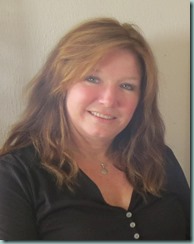
ConnieAndrews

Connie Andrews creates beautiful oil and pastel paintings in her home studio in Central Illinois. I met Connie through my sister and have worked with her on the cover of a still-to-come therapy book. Along with being an incredible indie artist, she’s a lovely person. I’m honored to have her here at Elucidations.


LK: Hi Connie, let’s start with something fun. What is your favorite color and what is it that draws you, so to speak?

CA: My favorite color changes from time to time. I would have said dusty pink a few months ago. Why? It is a rich color, not too bright and garish yet not too child like pink either. It feels fancier to me somehow. But right now, I believe my favorite color would be a deep maroonish cherry red. It is still in the same color family as the dusty pink, just much deeper. I am also creating a wax sculpture now and the wax I am using is about the color I described.

LK: I always find it interesting how favorite colors change with age and life events. Speaking of changes, I have to ask, since you transitioned from auto upholstery to reporting to becoming a full time artist, how did you decide to take that leap away from a traditional paycheck to working for yourself?

CA: Let’s see, I owned my auto upholstery business and my reporter job was freelance, so actually I have been pretty much self employed all along. I have had some side jobs along the way to supplement my income as an artist, though.  One day, while cleaning and organizing another self employed friend’s house, I had a revelation. I realized that I was helping her further her career by doing her mundane, time consuming tasks that almost anyone could do. While I was making a little money, I was not doing anything to help my career thrive. I decided right then and there that I needed to do something different with my time to make ends meet.

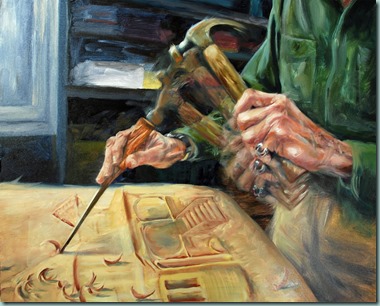
ConnieAndrews-IfIHadAHammer

LK: What are the benefits and drawbacks of being a self-employed artist? Are you finding it worthwhile?

CA: The benefits to being a self employed artist are many.  I am, for the most part, able to make my own schedule. If my muse decides to keep me up until 4am painting, then I am able to do that without having to worry about going through a 9-5 workday. Most of the time, I am available for my daughter. I am able to attend most of her school functions and  be with her on her summer vacation, winter and spring breaks, days off of school and after school.

I get quite a few commissions and for the most part, people hire me to create a piece of art for someone as a gift. I love meeting new people and being able to be part of their special occasions, in a background sort of way. 

Another huge benefit is that I am doing what I love, what I feel I was born to do. Paint, create, make feelings and ideas into 2 or 3 dimensional pieces of art that others can see or touch.

There are some drawbacks though. Lack of money can be one of them. Many people think that artists, being the caring people that they are,  should give their work away at auctions or volunteer their skills to help others. I feel like my skills are something I have worked hard at perfecting for many years. I know many mechanics, carpenters, and other professionals who are very skilled and wouldn't dream of asking them to perform their services for free. Why do people ask professional artists on a regular basis to "donate" their work or time?

The economy has also hit many artists. Art is, to many, a luxury, and therefore, sales are usually minimal when times are tough.

One of the other drawbacks is that when doing commission pieces, which so far is what has kept me going, I am trying to bring someone else’s ideas into being which sometimes can be difficult.  It is definitely a challenge to keep a balance between pleasing the customer and pleasing my own muse.

LK: I’m glad you mentioned the free expectations with art, since that’s also a big issue with writers. My thought is the same as yours. Artists work as hard as anyone at their craft. Why give it away free? I think it devalues what we do when we agree to that, but it can be tough to compete when so many do.
What reactions do you tend to get when someone asks what you do?

CA:  Most people are pretty curious when they hear that I am a full time visual artist. When my only studio was based in my home, I would get the reaction that conveyed they didn’t think I was a professional.  Being a resident artist at a studio outside my home seems to validate my reputation as a serious artist. 

There are so many people who say, “Wow, I can’t even draw a straight line without a ruler” to which I usually think “me neither.” I will probably always use rulers.

LK: I think I’d like to see the reaction when you say you can’t! It’s funny, and a little sad, that working at home gives that connotation, isn’t it?

Recently, you were called upon to to do courtroom sketches. Can you tell us about that?

CA: An artist friend contacted me because she had heard that a TV station out of Springfield  was looking for someone to be a sketch artist for the Christopher Harris trial. He was accused of killing 5 people in Beason, Illinois. It was a gruesome trial, but probably one of the most interesting jobs I have done yet. I absolutely loved the challenge of trying to capture the moment in the courtroom. I was there for the whole opening day with my pastels and paper. The day went by super fast. I was told by many people that they were surprised that the people I drew actually looked like the people in the courtroom. I thought that the whole idea was to capture a likeness and show what the scene inside the courtroom looked like. . I guess the reason it was such an exciting job was because it felt like there was a story unfolding before my eyes, and I was able to do one of  the things I love to do the most in this world, draw and paint.  I hope that I get hired to do more courtroom sketching.  I can picture myself doing that on a regular basis.

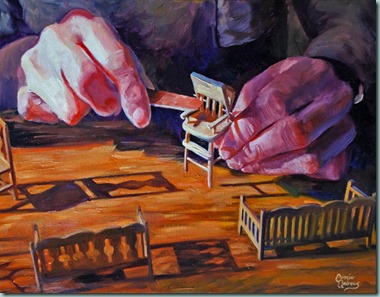
ConnieAndrews-MyFathersHands
LK:  The painting on your website home page, My Father’s Hands, is so touching and evokes love and respect as well as telling a story. In fact, I love every piece in your Hands series. How did that come about?

CA: Thank you. This is one of my favorite pieces. It holds a spot very dear in my heart. “My Father’s Hands” is the painting that started my hand series. My father, who retired from the Marines after 24 years, had very strong hands that had been through two wars. Yet he was able to use those same hands to do the delicate work required for these tiny dollhouse furniture pieces. I took pictures of him working with these pieces one summer in early June. I am glad I didn’t put off taking the photos. We had no idea that in about a years time he would be gone. I finished this piece just in time. I was able to show him the finished painting the day he died.

LK: Now I love it even more. That’s just wonderful. And I could go on and on about the military and gentle hands, but I won’t do there here. So, what are your favorite activities outside art?

CA:  I absolutely love to sing. I was hired last year as the song leader at Union Church in Brimfield. They asked me to direct the choir at Christmas and I discovered that I love doing that as well. 

LK: Very nice! I see you’ve done other book covers as well. Is that something you’d like to do more?

CA: Yes, I would like to do more book covers. I enjoy working with the writers/publishers to design a cover that will help to sell the book. It is also very satisfying to see my artwork in print.

LK: (Hoping my indie writer friends will give that a thought!) To bring more of the arts into this, do you listen to music as you paint? If so, what genre(s)?

CA: When I am by myself or won’t disturb anyone, I listen to music that I can sing to: Carrie Underwood, Daughtry, Bon Jovi, Faith Hill, Evanescence, Ray LaMontagne. If I am at my public studio, then I usually listen to music without words, like new age, instrumental or classical, so the temptation to sing at the top of my lungs is removed.

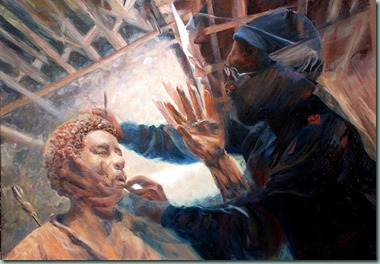
ConnieAndrews-BringingHimToLife 

LK: I promised this would be short, so I’ll leave off with one last question. Are there other indie artists in any field you’d like to recommend?

CA: I have so many artist friends that I don’t want to leave any out. The building I have my studio in, Studios on Sheridan [in Peoria IL], has 12-15 artists.  There is one woman by the name of Jill Goforth, that you, as a publisher, might be interested in since she creates art from books, using the pages and sometimes the spine to form things other than books.

There is also a women by the name of Jessica Ball, that has a business that seems to be the new trend. It’s called the Art Garage. People can show up for an hour or two and for a minimal fee, create a work of art or craft item with her supplies and guidance.

My studio partner, Gloris Young, has been searching for her visual voice for awhile and has possibly found it now in what she calls Pop Art Pets, funky, wildly colored, yet with realistically portrayed eyes.

There is Rebecca Draland-Doyle who is a very dear old friend of mine. Rebecca is a very dedicated artist who paints beautiful abstract pieces.

The list goes on and on, Billie Howd, Myra Branch, Steve Boyd, all accomplished visual artists.

If you are interested in musicians, Winston Dunbar writes music and plays in a few bands in the area. He has written some wonderful pieces that deserve more recognition.

LK: Connie, thanks so much for your time. I know you have a website at ConnieAndrews.com. Are there other links you’d like to leave?

CA: My Facebook page has lately been the place I keep most up to date. It is www.facebook.com/connie.andrews.560

One last thing, if you go to my website, there is a tab where you can sign up for my newsletter. Thank you Loraine

LK: My pleasure! Thanks again for talking with us!