Sunday, March 25, 2007

Who Are You?


"Attaining inner simplicity is learning to live happily in the present moment. Keep in mind that life is a continuous succession of present moments."
Elaine St. James

As I watch the views for my blog grow, I find myself wondering who is reading my words. This entry isn't about me or my thoughts or my work. It's about you. We all have stories. Share a piece of yours, if you will.

I used to get a newspaper that had short clips of life moments featured for local readers. I loved that more than anything else in the paper. They contained the most truth. I would love to do a version of it here. Write one or two sentences that reflects something about who you are. Many of us are parents, grandparents, writers, managers, laborers, etc. but that doesn't give us a clue about "who" is behind the roles we play.

Who are you?

Post anonymously if you prefer (please keep it PG rated), but give me some idea about the inner soul of those reading these words. I am fascinated by people. You never know if something I read will wind up in a story in some way.

Sunday, March 18, 2007

live creatively free


To live creatively free, do what you know how to do now then 'act as if' you know how to do the rest."
Sark


How closely should art force itself to follow reality?

In many ways, art has to be more real than reality. Fiction has to make sense to readers. Life doesn't have to make sense. In fiction, each story has a beginning, a climax, and an ending where everything comes together in some kind of tidy manner. Life isn't so tidy. Things don't make that much sense in our real worlds. The problem comes when the two mix and mingle, such as in historical novels and movies.

300, the film starring Gerard Butler, an actor who is finally getting mainstream recognition after many years of being largely and unfairly ignored, is getting incredible reviews. The story of the few trying to overcome the many has echoes of so many situations we see on a daily basis that it has become irresistable to audiences. Let me say first that I have yet to see it. I will. It's actually one I would wait for the video since, although I love history, I don't watch many war movies of any kind. I do have plans to see it in the theater, though, simply to help support this actor and help push him further into mainstream view. I like that it doesn't have a bunch of huge names in it, also. The focus here seems to be the story line and acting ability instead of name-dropping. I have to appreciate that.

I did read one review of a history buff whose son (also a history buff) went to see it and came back complaining that it was historically inaccurate. I found myself on both sides of the issue. I also love history. I feel it's very important to understand history if we are to understand the present and future. However, I'm also a fiction writer and understand the basic elements stories have to have in order to pull and mesmerize audiences. The intended audience for such a film expects action and splendor and scenery (which kind of scenery may depend on gender) and without it, regardless of how historically accurate it might be, the reviews won't move it past the preview weekend.

The point of a movie, its main theme, is what an audience will remember if it's done well. Does the director's vision for what s/he wants the audience take home allow the right to artistically recreate history? Maybe. What is the point of knowing history? Remembering each detail or learning from its message? I tend to think it's the message that's important. Memorizing each date of each event in high school and college history classes seemed insane to me. They weren't going to be remembered past the test date. However, what I got from the story of it, I kept.

Movies are fiction, unless they are specifically labelled as documentaries. If they make us stop and think, then maybe we'll go do the research ourselves. If we don't research, then we at least get the main point of the story. There is not one historical novel, including those hailed as classics, that does not play with historical fact to make it work within the story. Does it invalidate the history? Of course not. Will it lead readers to do more research on the time period to get more actual facts? Not very often. Most readers and viewers want entertainment. If they can learn a fact or two along with it, that's great, but those who want non-fiction read non-fiction or watch documentaries instead.

By the way, it's hard to tell how much of what we learn in our history books is actual history, as well. It's all slanted by whoever is telling the tale and by the individual teachers injecting their personal opinions. History always has been. Are the facts actual facts? Were they fictionalized in the first place to make them more interesting? Possibly.

Nothing written or spoken is ever done without the viewpoint of the writer or speaker involved. Nothing heard is ever taken in without the viewpoint of the one doing the hearing mixing it with personal opinion. At least in fiction, we are saying outright, "This is not fact. This is a story of my own creation in which I mixed real things with non-real things with imagination with personal opinion with belief with wants with needs...." Will the reader still get something worthwhile out of it? Of course.

Tuesday, March 13, 2007

A Walk In The Garden

"I try to live what I consider a poetic existence. That means I take responsibility for the air I breathe and the space I take up. I try to be immediate, to be totally present for all my work."
Maya Angelou


As any gardener knows, a simple walk in the garden is never simple. The beauty others see upon viewing the results of her work cannot compare to the thoughts of the gardener while walking along her flowers. She sees not only the hours of work already put in, but also the hours yet to come and the details she is not quite happy with that she wonders how to improve.

In a way, her garden is more beautiful to her than to anyone viewing it in passing. In another way, it can never be quite as beautiful as others see.

Other artists understand her. Painters visit an art gallery and see the work lying behind each piece. They listen to compliments of their own work and burke the thoughts of knowing what could have been done better. Dancers feel the pulling of muscles and strains and fatigue while watching other dancers while the audience sees only the grace and beauty.

Writing is the same. We hold our books in our hands and read reviews, thrilled to see when a reader 'gets' what we are trying to say behind the words, humbled at the request for a signature, and thankful for each sale. At the same time, we don't see only a pretty (or scary or mysterious) cover and many pages full of a story. We see hours upon end of writing and rewriting, editing and pondering, deleting and redoing; and we especially relive the questions that plague us through the whole process. Are we accomplishing the beauty that is in our minds well enough? Will we affect readers enough to make some difference in their worlds?

Our walks through our books are filled with these questions as well as with thoughts of what we want to do better the next time, what weeds we would like to pluck off the printed page to replace with a rose or sunflower or carnation.

In the meantime, we focus on marketing, on finding readers who may enjoy our stories and our characters.

Much of my winter has been spent focusing on marketing. My website now offers a press kit for bookstores, a special offer for reading groups, and a brand new newsletter to offer information on happenings with my writing and in the indie arts. I'm quite glad to announce a new arts feature, as well: An Interview With A Musician. You'll find the first, a chat with Johnny Roxx,renowned guitarist, posted on the indie arts page.

I would also like to publicly say thank you to the two fans who are running Myspace pages for my three main characters from Rehearsal. Liz and Jan, I can't thank you enough for your support and assistance.

You'll find the first three chapters of A Different Drummer in the characters' blogs, one in each blog, beginning here: http://www.myspace.com/duncan_rehearsal
The prologue can be found on my site: http://www.lkhunsaker.com/DifferentDrummer/excerpt.htm

Spring has arrived, and with it, I am not only back to working in my flower garden, but also obsessive about furthering the second book of Rehearsal, entitled The Highest Aim. Does anyone know from which quote the title comes or the author of it?

Also with spring comes spring cleaning. As I'll be changing residences soon, I have been clearing out things I don't want to have to unpack and store in the new house. The fewer things to move the better, in most cases. So I am also going to start offering a "moving sale" on the copies of A Different Drummer I have in stock. I hope to publish The Highest Aim this fall and would like to make room to stock that one next.

Watch either Myspace (http://www.myspace.com/lkhunsaker) or my newsletter (http://www.lkhunsaker.com/newsletter) for details.

Wishing you all a poetic existence,
LK Hunsaker

Sunday, February 11, 2007

Abridged Arts


"People had longer attention spans.... The works have been abridged to make it easy, more accessible for the TV generation."
Mikhail Baryshnikov


I clicked on a link tonight that asked how many were planning to watch the Grammy Awards. Welcoming the chance to say, "No, thank you, I have better things to do," I was pleasantly surprised that the majority of voters agreed.

I love music. I used to watch all of the music award shows years ago in order to get a chance to see some of my favorite singers and musicians. And then came the MTV/VH1/CMT generation where we could watch them anytime we decided. I did watch videos for a while. Rarely able to attend concerts, I used them as a substitute, having them on as often as my radio, or nearly. Now they are all over the internet. Is it any surprise award shows have lost their charm considering the availability of picking and choosing who we want to watch instead of whomever the powers to be decide to invite?

As a curiosity, I did click the link that told me who was nomimated for the top three awards. After wondering if I had the right list, I could see why so few are interested in watching. Has music declined that far? There was not one act I care to listen to on the radio, much less waste 3 hours of precious time seeing who comes out "ahead."

I posted this in my daily journal and another writer replied it's the same in the writing world. "Poets" who so apparently haven't studied the artistry and technique of poetry are publishing their works. Essays are nothing but rants without real thought other than fleeting anger. Journalists who have forgotten or never bothered to learn the concept of integrity of the written word abound in print and online. Where is the artistry in the arts?


I am an advocate of the indie arts. I'm an indie artist. The internet has become an incredible tool for those outside main genre publishing, in both music and writing. Readers and listeners now have many more choices than one of the niches that big companies pick up and put out there. Artists now have a free venue with which to promote themselves. It is a wonderful thing.

On the other hand, it has also given some a false sense of "art." The number of works being pushed out into public view without being ready is alarming. I receive many, many friend requests from indie bands on Myspace. I don't mind getting them, and I always go give them a listen. Many I add because they do have talent and I like their sound. Most now, I refuse, either because it isn't my style or because I flat-out can't fathom why someone told them they were ready to publish their music.

The same applies to writing. I can go to a writer's site or read their emails on a writing list and know they can't possibly be someone I want to read. Yet, they are promoting books they've published, likely without professional editing. Some writers can get away without professional editing, as long as they have someone else reading their work to find things a writer cannot see in her own work. Some are attuned to grammar and only need an extra eye and suggestions about the plot or characters. Some have incredible stories and a nice way with words and only need grammar assistance. Some have neither, and yet, because they "wrote a book," they decide it needs to be published.

Poetry books are being published without the "poet" realizing it takes more than rhyme and a certain number of lines to be actual poetry. There's an artistry missing that cannot be faked.

There is artistry missing in much of the arts.

In this TV generation, we are full of the glitz and glamour of things without bothering with quality. Our actors don't have to know how to act. They only have to know how to put on a show and flash their smiles. Our politicians don't have to be well-trained in how to command or lead. They have to be charming and look good on our screens. Our singers don't have to know about the intricacies of music. They have to be actors who can make those clueless about music vote for them. Our writers don't have to train themselves on the techniques of plot, characterization, climax, endings, sentence structure, or poetic use of words. They have to know how to create book trailers to catch attention with "book videos."

Of course there are exceptions. There are many indies doing glorious jobs and I love that they have the means to let their work be known. I only wish the artistry would come before the promotion instead of our arts becoming so abridged.

Saturday, February 03, 2007

stripped enough


"Dancers are stripped enough onstage. You don't have to know more about them than they've given you already."
Mikhail Baryshnikov


Is imitation really the sincerest form of flattery?

I can see how it is, in a way, but isn't being inspired by someone enough to want to be just as individually unique as that person even better?

I have many favorite authors, such as Marilynne Robinson, Hemingway, John Irving, John Jakes, and so on, but when someone asks who my work resembles, I'm at a loss. Nora Roberts comes to mind, but her characters aren't particularly deep. I appreciate the style of the "Johns" ;-) but mine isn't at all like theirs, other than being literary. Marilynne Robinson is someone I aspire to come close to approaching as far as the gorgeous, flowing, lyrical prose that seemlessly blends with her beautiful, flawed characters, but I don't attempt to imitate her style and never expect to have that nearly unattainable quality. She is a true inspiration, and managed to achieve it with her first novel after focusing so long on non-fiction.

Currently reading The Awakening by Kate Chopin, I can see why it's such a classic. The story is so true for so many and the writing is calm and easy. It doesn't have the depth of character that I insist on having in order to call it a favorite, and it's slow enough that it doesn't keep me pulled in except occasionally. That is, of course, a quirk of my own that I am so easily bored and distracted, and others wouldn't agree.

I do have to say I would be flattered if another writer even wanted to imitate my style, but I would rather they didn't. Is that vain? No, it's art. Learning from others is an incredible way to improve, just as the master painters once copied paintings of their predecessors. The ones who stood out, however, were those who took that training and used it to create their own style.
Many authors worry about "finding" their voice. *shrug* Why search for something already inside? It's there; let it flow naturally and that is your voice. It's unique, and that's your hook.
**
I missed last week's entry because I've been furiously working on marketing, to include revamping my website, adding a press kit for bookstores, and coming up with promotional ideas, including a brand new animated banner for fans to use on their myspace pages or elsewhere. There will also soon be freebies on my site.
One thing I am excited about is the addition of "A Conversation With A Musician" that is now up and running. The first interview is posted: Johnny Roxx. Johnny has been featured in several major music magazines. Check out his interview!

The plan is to have a new musician/band each month, all indies (although they may have been signed earlier), and to extend it to other types of indie artists. If you know an indie artist with an established record who would consent to an interview, let me know. I have several in mind, but will take suggestions.

Punxsutawney Phil didn't see his shadow, and I'm quite happy about that. On toward spring....

Sunday, January 21, 2007

in its own right


"For me, a landscape does not exist in its own right, since its appearance changes at every moment; but the surrounding atmosphere brings it to life - the light and the air which vary continually. For me, it is only the surrounding atmosphere which gives subjects their true value."

Claude Monet


If you're ever in doubt, ask your friends.

I have read much information about writing: the process, techniques, advice, opinions, marketing, publishing ... so much that it tends to blur in my brain. Sometimes, though, something I read stands out.

The other day I read a writer's blog that discussed certain niches that each fellow blogger used to pull in readers, consciously or not. It picked up a thread of something else I read earlier of the opinion that writers should pick one niche and stay with that. I wasn't so sure. I think it depends on the writer. There are those who can 'float' into different territories and those who are best staying with familiar territory, or possibly, they stay with familiar territory by choice only.

It made me wonder, though, if my blogs had a certain hook that pulls readers. My writing.com blog is the one full of daily rambles and is markedly eclectic. I pondered for two or three days about what my hook was and if I had one. I decided I wasn't sure. So ... I asked ... in my blog. I simply wanted to know what my hook was or if anyone else could find what I couldn't.

I haven't begun to reply to the responses because I was rather overwhelmed.

Doubt is a constant companion to writers, and artists in general. I found a definite cure for it Friday by asking friends/readers directly what they thought. I won't embarass myself by repeating answers but apparently, I do have a hook, or maybe two or three.

This is something not only artist-types should keep in mind as we trudge through the world sometimes wondering why we are, but that all of us should. We can feel we don't make a difference, that we're boring or ineffective or unimportant in the grand scheme of things. However, we are quite wrong. There is not one of us that doesn't have an affect on those around us. There are people who care even when we don't realize.

As January rolls through and winter (in this part of the world, anyway) takes a firmer grip with fewer hours of sunlight and longer cold spells, it is easy for us to see the blah of things. If you need an uplift, ask your friends. Ask them directly, either in person or in a blog or an email or however you prefer to communicate. If you are lacking in companionship, join a group and get involved. Most people want to help others. Most are kind souls. It's not really so hard to figure that out when we throw ourselves into the midst of things.

We have snow today; our first snowfall of the season. While I look out the window at the gray, I focus on the gentle gracefulness of water frozen into beautiful white crystals floating down to coat the still-green grass (and my already growing daffodils). It marks the upcoming new beginning when nature will come out of its slumber and revive us with a vigor we only feel in early spring and with rainbows of flowers and shrubs and blooming trees. Now that winter has truly begun, I can see its end and its end results.

Nature's hook is its being; its overwhelming ability to affect all of us without trying by simply doing what it does. We are all part of that.

Saturday, January 13, 2007

A Rehearsal Sampler


This is only a sample of my work ... the beginning of Rehearsal: A Different Drummer.

To find a larger sample, see my website.

(Can you tell I have nothing on my mind worth blogging about?)


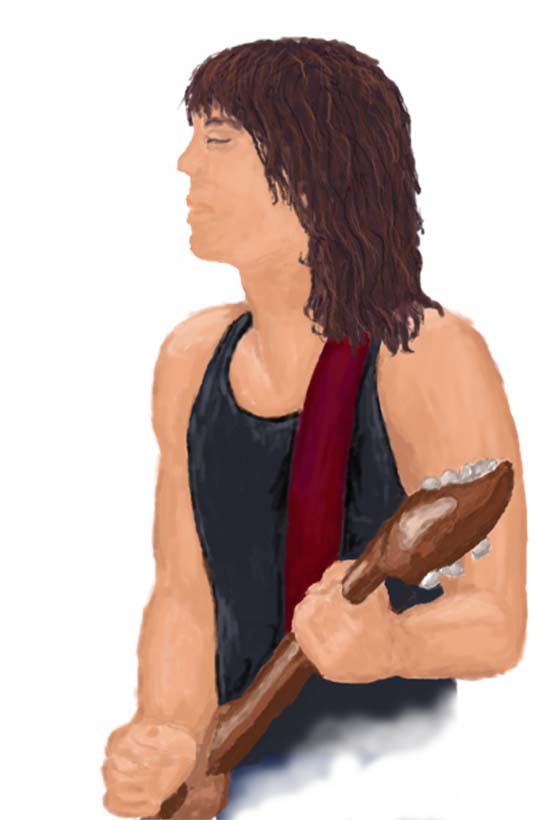
artwork: Duncan by LK Hunsaker (all rights reserved)


Spring, 1972


“Hey sweetie, wanna dance?”

Duncan raised his arm to wipe sweat rolling under his chin onto his sleeve and threw her a glance, not bothering to turn the bar stool in her direction. Shagged brown hair topped her average-height frame, not much shorter than he was, he supposed. Modern, including her willingness to approach him in such a direct manner. “Thank you, bu’ I am workin’.” He looked back to check on his ordered beer, smoke choking his mouth and throat.

She moved closer. “Not at the moment, you’re not.”

Returning his eyes, he noted a tenacity in her expression and body language. A quality he liked, to a certain extent. “Well, y’ are right. At the moment, I am tryin’ t’ cool off a bit. Then I am goin’ back t’ work.” A trickle of sweat began rolling down the side of his face from underneath the damp hair falling over his forehead, and Duncan leaned his head forward to pull the bottom of his T-shirt up, rubbing it across his face and letting it fall again. Then he shoved the hair out of his way, irritated at himself about forgetting to bring an elastic to pull the back of it off his neck. It was sticking against the wet skin.

Accepting the mug that finally came across the bar, he took a large swallow, enjoying the coolness of the glass against his hand and the stream of liquid pouring through his body.
The girl cuddled into his shoulder, a musky scent accenting her warmth. “Are you ever here when you’re not working?” Fingers with painted nails touched the bare skin of his arm.

Ignoring a snigger from the bartender, a new employee Duncan didn’t like much, he again raised the mug to his lips, allowing time to consider an answer, to let the weak American beer quench the dryness of his throat. “Now and then.” The chill of the glass distracted him from the girl’s flesh pushing against his.

She broke through, sliding both hands around his fingers and the heavy mug, pulling it from him. “So maybe you’ll dance with me another night?”

Looking up to question her, he watched as she sipped his beer, keeping her eyes on his. Narrow eyes. Lashes painted longer than natural matching thick black lines extending from the corners; the brushed-on green of her lids attempting to extend the brownish-green of her pupils. It didn’t work well.

She rubbed a finger around the edge of the mug. Offering.

Duncan studied her. She wasn’t bad-looking. Fake, but not snobbish. And who was he to be too particular? “Maybe.”

She grinned, pushing the drink back toward him.

“Keep it.”

He watched her move away, flaunting the beer to her table of friends, repeating the conversation, he figured, making it more than it was. Duncan never understood the infatuation girls had with guys in local bands. Hell, this wasn’t even a good local band. His mates were okay guys, as far as it went, but barely third-rate musicians. It didn’t seem to matter. They were just background noise for the pick-up lines and the attempts at relaxation by intoxication in the dark out-of-the-way bar.

And dark was helpful. It disguised the niched plank floor and scratches in the old wood tables with only patches of varnish left as pointless protection. Duncan could imagine his mother cringing about him playing at the little dive, though it was better than many he’d played. For the most part, it was kept clean, though likely not clean enough for her. He was just as glad she didn’t know how he was living – day to day, city to city, jumping from one third-rate band to another while doing whatever other cash jobs he could find.

Ordering another beer, he watched the small crowd, studying the ones he recognized as regulars and the few he didn’t. Mostly, he played to the same group every weekend. It was only a paycheck. There wasn’t one, he imagined, who would even know if he played a wrong chord now and then. They weren’t listening, not more than enough to go through the motions of dancing, or swaying somewhat to the beat. Their drummer was at least decent. They kept a good beat going.

A movement from the table of Thiel College students caught his attention; they were always easy to spot, dressed too well for the bar full of locals and holding their chins higher than necessary. One of them actually rose to retrieve his drink from the bar instead of barking an order at the girls serving. Duncan watched him: the only male at the table without a cigarette hanging from his mouth or fingers. Worst part of playing in bars; the damn cloud of nicotine.
The guy was heading in his direction. Duncan turned back, waiting to catch the bartender. “Is tha’ beer comin’ tonight?”

“Make that two. And a wine spritzer. After his, of course.” The guy stood beside him.

Wine spritzer. For the girl at the table sitting sideways in the chair with her legs crossed and her shoulders straight, Duncan guessed.

“How long have you been playing?”

Glancing up to make sure the college guy was talking to him, he answered … barely. “A while.” He looked away again.

“Obviously. I meant, how many years?”

“Why?” Duncan raised his hands in a questioning gesture at the new bartender. He would have to go back and play before he ever got it, at this pace.

The intruder took advantage of the stool next to him being vacated, and planted himself as if he actually belonged in the bar, raising his voice to talk over the recorded music played between sets. “You’re wasting your talent here. You’re a hell of a guitarist.”

Duncan looked over, unable to completely dismiss the compliment, since it wasn’t from a girl this time. He sincerely doubted this guy was hitting on him. “You play?”

“Not much since I started school, but when I can.”

He nodded slightly and turned away again. Another beginner looking for pointers. Well, he had better things to do than to waste time on a college student who wanted to learn just enough to pick up girls.

“So, why are you here?”

Duncan’s back straightened. What made this guy think it was any of his business? Holding his thoughts, he stood. He would rather hang with the band, though he didn’t care much for their company, than to be harrassed by some stranger.

The college student stood up beside him and Duncan swung around. “Man, wha’ do you want?”
(Literary romance for ages 16 and up.)

Sunday, December 17, 2006

Chi Rispotta

LK Hunsaker 2006

"Chi rispotta sara' rispottato."
(Respect others and you will be respected.)
-- Italian Proverb --


There is a "celebrity blogger" being sued by the paparazzi: a rather ridiculous thing by the sound of it. I find it deplorable for people to stalk and otherwise harass other people in the guise of "freedom of the press" simply because photos and stories (true and otherwise) of those being stalked bring in big money. It's truly disgusting and should be illegal.

On the other hand, this blogger is making money from those doing the stalking by doing something unquestionably illegal: reprinting photos taken by others on his blog with no permission and no credit given. This is outright copyright infringement. He is claiming "fair use" under the copyright act. As a writer/artist, I have studied the copyright laws enough to know that the way he is using the photos, by drawing a couple of scribbles on them and sticking rude captions underneath, is not at all fair use. Fair use was issued for educational reasons. It gives us the right to use quotes as long as they are brief and acknowledged. It also gives us the right to show photos of artwork for an educational purpose, again with credit given.

While checking into the creation of my own website, I read that section thoroughly: the one he is quoting as fair use that says if he changes it, it becomes legal. That's not what it says. It says there must be a considerable change and even then, the law is hazy and it would come down to how and why it's being used. In general, if it is being used for purposes of making income, it's not legal. The biggest issue is whether it interferes with the owner's income as competition. That is a cut and dry illegal act.

I'm mentioning this here because of the widespread copyright infringement happening online. It is not legal to copy photos/graphics/text online and use it for your own purposes without express permission from its owner. That goes for any kind of art, including literature.

One of the comments in that blog mentioned something I've heard ranted about before; that copyright laws should be repealed. This apparently comes from those who have never in their lives created an original work and never intend to do so. My question to those people would be, "Why should everyone except artists expect to make money from what they do?" Or, "Why should certain artists be allowed income from their work while others aren't?"

When a man contructs a beautiful oak rocking chair from his own labor, no one is allowed to walk into his house and take it away. It's stealing and it's illegal. When I sit down and write or create graphics, I am putting my time and learned craft into it in the same manner and my work belongs to me. The photos I take and include in my blog and on my site belong to me. Copying them without my permission is stealing. The same goes for everything anyone creates.

A photo is a creation. It takes skill and knowledge and effort to create a good photograph. I disagree about the ethics of the paparazzi, but it is not illegal. Even if it were, two illegal acts do not cancel each other. Copyright infringement is illegal. Plagiarism gets college students kicked out of school and adults fined. It is all the same issue. Art is meant to be shared with others, by permission of the artist. It is not meant to be stolen.

Most often, if photos are used and linked back to the owner's site with full credit given, there isn't an issue made of it, especially when it is on a non-income-earning site. Some artists would welcome that as additional exposure. However, they could very well make a legal stand if they chose to do so, even with full credit.

The bottom line is that artists deserve respect for their work. They deserve the same protection others have when it comes to earning a living. Grabbing art that is someone's livlihood (or even if it's only a hobby) is the same as walking into someone's house and pulling out one of her belongings.

If we wish to continue having art in our society, we must continue respecting our artists.


-- story link: http://movies.msn.com/movies/article.aspx?news=245243&GT1=7701

Sunday, December 10, 2006

awe-inspiring vs. clearly visible

LK Hunsaker 2006

"A friend who is far away is sometimes much nearer than one who is at hand. Is not the mountain far more awe-inspiring and more clearly visible to one passing through the valley than to those who inhabit the mountain?"

Kahlil Gibran

How close should a writer get to her public?

The same could be asked of any artist, I suppose. I asked this in my other blog, one mostly read by other writers, and received varying answers. Writer's Digest also covers the question in this month's issue. The majority consensus seems to be that readers appreciate being able, with the internet, to connect more closely with their favorite writers and that it is also helpful to writers to be able to receive such personal feedback.

I think there is a fine line and determining when it's crossed can be tricky. Mountains may be more clearly visible from a distance, but there are wonders about them that only those who get closer can know and learn to truly appreciate their inspiration.

Artists are fairly mysterious creatures to others and that mystery can be a good thing; it helps to create an aura around their work. Too much mystery, though, can lead to detachment. Look at characters in novels who are under-developed. They may be going through exciting or horrendous adventures, but unless a reader can delve in far enough to see who they are inside, why should they care how the adventure unravels?

I have many favorite artists of all types. I can admire their works and enjoy reading/listening/viewing. Still, there is a distance that equates to one who sees the bare outline of a mountain and thinks it beautiful, knowing nothing more. Why do so many of us wish to meet our favorite artists? Because it gives us the opportunity to walk up that mountain path and see what kind of trees are growing on it and from where the colors and shadows stem and what else lives inside its depths. It creates a different kind of awe, a more visible relationship that helps us connect further, and to care more.

The advent of online communications with not only authors but artists of all kinds allows for an experience so few have been able to afford in the past; a chance to "meet" the creator and look inside its depths.

Artists should take care, though, not to reveal anything that gives too much away about their work. Their creations need to stay distant to an extent, to stay mostly hidden until completion and then to maintain a bit of mystery. There needs to be an allowance for the audience interpretation. I adore that rare opportunity when I get to hear a reader's interpretation about my work. It so truly shows that a writer is only part of the equation. Each reader brings a uniqueness to the work that helps make it more personal to her. That boundary needs to stay uncrossed.

I would love to hear thoughts on the issue from writers and readers alike.

A note: With the holidays upon us, my weekend entries may slow or cease until January. I wish you all a Beautiful Christmas/Hanukah/Al Adha and a wonderful 2007!

Sunday, December 03, 2006

The Test of The Artist


"The test of the artist does not lie in the will with which he goes to work, but in the excellence of the work he produces."
Saint Thomas Aquinas


Many times during Nanowrimo, I nearly threw my hands in the air and said, "I GIVE!"

I ended up pushing through. In fact, the closer I got to the deadline, the more determined I was to finish, to not only hit 50,000 words, but to finish the whole first draft. Averaging 3,000 words a day the last week, I made it there on November 30th, with over 51,000 words. I've never written a novel that short, but then, this is my first youth novel, and it's long enough for 13 - 15 year olds. It will likely end up shorter than that once I take out everything that doesn't have to be there and tune it, turning it into something readable. It doesn't yet have a title; since I wrote it for my son, I'll ask his help in naming it.

I'm letting it rest during this month and will hit the editing in January after it's had time to settle and I can go through with a more vivid and distant eye. I have plans of publishing by May. It's a possible goal since it is a shorter novel.

On the last day, I also spent a bit of time browsing the Writers Beware blog (link on the left) and found an entry about how a high percentage of Nanowrimo authors are being scammed by "publishers" and "agents" because so many Wrimos are new to the writing craft and susceptible to those offering the flashing star of having a book published. Yes, I suppose that happens, but I have a hard time believing it happens to Wrimos more than to others.

Have you spent time at Yahoo Answers? I am often there perusing the books and authors questions and am highly disdained to see how easy so many people believe the whole writing thing to be. One asked if there was someone who could help do the "details and descriptions" and such. She had an idea and decided it should be a novel. *sigh* I imagine I won't get any thank yous from telling her that ideas are a dime a dozen, but that's the truth and she needed to hear it. She likely also didn't appreciate my telling her that learning how to write details and descriptions is part of the writer's job, or that if you don't want to spend hour after hour editing 2,3, or 4 times after the first draft, don't bother with the first draft. Was that harsh?

I run an indie-publishing group. One of the things I stress is that it's not the easy way out. It's harder, in fact, not to get it published, since anyone can do that now, but to get something marketable published and out there and reviewed by someone other than family and friends. I cringe when I see self-published books that come off as though they are first drafts. Likely, some of them are. It hurts all of us when hobby writers do that. And I say hobby writers because studying, editing, learning, and then editing more is part of writing. There is a difference between those who write for fun and serious writers intent on constantly improving and learning the craft and studying the production process and marketing strategies. It's hard work. An idea does not make a book.

Of course, there's a place for actual vanity books. Having your family history in print to give your grandchildren is a nice idea. Putting down a story in your head and getting a few copies in print is nice. Anyone should have the right to do that. It is vanity, and it's fine. Your family won't care if you have spelling errors or extra information or an undeveloped writing style. Anyone who pays money for your book, however, most certainly will.

The scam comes in when someone tells you not only can they publish your book, but that you will make money from it. Many other questions I found about the publishing process and financial outcome of writing a book were answered by those saying immediately, "publish it yourself and you'll make money" or "get an agent so the big companies will accept it." *sigh* Yes, because it's really that easy. (sense the sarcasm here?) I have spent too much time there trying to clarify the process, to steer unknowing victims away from paying an agent to accept you as a client [legit agents do NOT ask you for money -- they get paid from selling your book!], or from thinking because they have a complete draft of the book that they can find a publisher, or that it's only real publishing if one of the big traditionals accept you. The big companies produce only a small percentage of books published each year. Small companies are producing much more, because there are so many more of them. I have echoed myself saying that who publishes a book is less important than how much work the author puts into marketing. Also, being published by a big company does not necessarily equate higher quality. It only means you wrote in a currently hot-selling genre and the book wasn't too awfully hard for editors to help spiffy.

At the moment, I'm reading Diana Gabaldon's Outlander, published by Bantam Dell. It's a good story, has sold well enough to reach New York Times Bestseller status, but is in desperate need of editing. I find it unbelievable how much work should have been done on it before final publication. There are many scenes that are completely unnecessary and do nothing more than make the book longer or to show off the author's knowledge of something or other. There are repeated words, changing tenses that throw the reader, and sentence structures that could use much improvement. The beginning was nearly the end for me, as stiff and pretentious as it sounded. Its saving grace is one character, who is not the main character. I can't find it in me to like the protagonist, or to even sympathize with her. I often know where the story is leading before it gets there. Still, it was her first novel and I can hope the next several improved.

While reading bestselling books and finding so many things that could be improved, I am both irritated and energized; energized because I can see that with consistent work, it is easily possible to write at least as well. Irritated ... because books that are indie-published are quickly negated although the writing is at least equal quality. There are some that are. The difference is we have to work much harder to prove ourselves. We may not do it willingly, but if we are serious, we will do it.

For those who enjoy poetry, I have been accepted by Sage of Consciousness and published in their most recent literary ezine:

Sage of Consciousness
(will open a new window)

Go to the poetry section and scroll down to LK Hunsaker. Then please, come back and let me know what you think. I can take it. Writers must develop thick skins.