Moondrops & Thistles is out already. That is, the full version is out (and getting nice reviews!). I’m still working on the shorter & spicier version (and got an A+ rating on my first actual “love scene” from a fellow author who does tasteful, romantic love scenes). Of course, a different version requires a different cover. So when I happened upon this blog cover contest today, I couldn’t help use it as a chance to push myself to revamp the cover for the new edition. This is what I have. I used sketches of the characters I created for the trailer and put them in place of the Canna lily. It may not be the final version (might depend on comments), but thoughts are welcome!
And go vote here (for what you like best!):
A Writer's Journey: Book Design Contest


Wednesday, August 31, 2011
Cover Contest/Blog Hop


Tuesday, July 05, 2011
Goodreads Giveaway: Moondrops & Thistles
Goodreads Book Giveaway

Moondrops & Thistles
by LK Hunsaker
See the giveaway details at Goodreads.
Friday, June 03, 2011
Be Wary Of What You Honor
 It’s graduation season!
Some of you and yours have hit that special day. Others will do so any day. Endings that lead to new beginnings are fully in our thoughts these days. Commencement speeches will honor those who have done well with their achievements and encourage all to continue to achieve, or to change course and start to achieve on new paths.
The valedictorian and salutatorian who have sailed through with flying colors will address the rest of the class. Awards programs show who sported the best grades.
However, in between all of the pomp and circumstance for those who did and whose grades show they did, be wary of bestowing more honor on those who got there easily than on those who struggled much harder to get as far as they did.
Let’s face it: school is far easier for some than for others. Some of us book learn well, sit still well, listen well, learn by lecture well. That’s wonderful. It is.
How many of us, though, don’t? If you are one of those who have struggled through learning by lecture, have trouble sitting, have trouble focusing, have trouble reading (and you know who you are: dyslexia, autism, ADHD, other learning differences, home life struggles, emotional issues…), have trouble feeling like you CAN, get distressed by how easy it is for those around you when you have to put four times the effort to achieve half the result…
This post is for you. CONGRATULATIONS!
You’ve learned more than book knowledge. You’ve learned how to struggle. You’ve learned to overcome, to persist, to stand up for yourself, to try and try again, to not give up on yourself even if it feels like everyone around has given up on you. Did you pass the test? Do you have that diploma in hand?
Then good for you! Your path is just as bright as the A students, the honor cord crowd path. You have just as many options, just as many credentials (they may be different, but there are as many), just as much opportunity.
Simply KNOW you do. Because you do.
How do I know? Yes, I’m part of the honor cord crowd. But a little secret: I spent probably four times as long on my homework to get there. There were many days I could not focus and I had to go do something else until I could, leaving me to finish at midnight so I was tired the next day. Science and math concepts felt so far over my head I couldn’t even touch them with my fingertips. With some help, I struggled through. Maybe I didn’t get better than a C in those classes, but for me, that was success. And I claim that success.
I also struggle with social phobia. No, not shy. Shy is different. I get nervous talking to a friend, even a good friend. Still, when I need to make money, I work. I’ve smiled at customers while cringing inside. Now, although I can work at home for the most part, I go to book signings and force myself to talk and then go home and crash because the social exertion is exhausting. But I do it. Because I can. If I will. I still have bad focus times where I have to go do something besides write. Then I come back to it later. Or I put music on in the background to help my focus. I’ve learned tricks to be productive, to get through issues others don’t understand.
So can you.
Whatever your obstacle, you have it for a reason. The reason: to learn to overcome. That’s a lesson that will help you thrive more than any other lesson on earth.
Overcome. Keep going. Stumble. Fall. Get back up. Keep going. The earth is round, indeed. You won’t fall off. Simply keep getting up and know you can get up and some days will be glorious while others are not so much. Fall. But get back up.
And never mind those “top of the pack” people. Be glad for them. They worked to get there, also. Don’t put them down for being as they are, and don’t allow them to put you down for being as you are.
Stand straight. Don’t be arrogant about it. Be humble (you’ve not done it by yourself; remember that, and be gracious to those who have helped along the way). But don’t look down. Look straight ahead. And keep going.
CONGRATULATIONS! Now, commence with the next part of your life and choose the path that will make you happy and that will support you. If you are supporting yourself and you enjoy what you do, and you don’t step on others to do it, then you’ve made it. Pat yourself on the back.
And keep going.
---
Sunday, May 29, 2011
A Life of Service
“If you get to read this, I will have died in defense of my country and all that it stands for—the most honorable and distinguished death a man can die. It was not because I was willing to die for my country, however—I wanted to live for it—just as any other person wants to do. It is foolish and foolhardy to want to die for one’s country, but to live for it is something else.
To live for one’s country is, to my mind, to live a life of service; to—in a small way—help a fellow man occasionally along the way, and generally to be useful and to serve. It also means to me to rise up in all our wrath and with overwhelming power to crush any oppressor of human rights. . . .
Try to live a life of service—to help someone where you are or whatever you may be—take it from me; you can get happiness out of that, more than anything in life.”
Captain Henry T. Waskow, U.S. Army, WWII
~~~ ~~~ ~~~
 You’ve heard of Gomer Pyle, but have you heard of Ernie?
Ernie Pyle was a war correspondent during WWII. The soldiers loved him because they could see how much he cared for and about them, how much he wanted their truths told. And he worked beside them and put himself at the same risks they were taking. Killed by sniper fire, Pyle left behind a collection of war stories from 1938-1944. Find more info at The Library of America, to include his account of how Captain Waskow, largely the source for the 1945 movie, G.I. Joe, was brought down the mountain in Italy.
Journalism these days seems much different than it was during WWII. Sensationalism has taken the place of dirty boot reporting. Anchors must look good and be charming. Certain segments want to shut down news stations that are on the “other side” (never mind we should all be on the same side). And indeed, our media shows much more divisiveness than cohesion.
Many soldiers these days are afraid to be interviewed because so many of their words have been skewed. Are there still reporters out there like Ernie Pyle who reported what he saw and heard without slanting everything toward his personal viewpoint or toward whoever is paying for his viewpoint? I have my doubts.
I’m not naïve about WWII days. I realize there were then, too, skewed reports and such. It’s impossible to have any written record that is not skewed in some manner. Facts always bend to personal bias.
Still, it seems since the Sixties, our military has been largely a political tool for the media and politicians (which go hand-in-hand). They know they are. So much for the days of Hemingway’s from-the-hip saying what he saw and Vonnegut’s true life experience being the voice of war. Now it’s pretty-boy look-at-me broadcasters followed by cameras who likely-as-not go for ratings rather than full truths. Why else, when we are told about children in war zones killed by “our” forces do we not also hear why they were killed, about how they had bombs strapped to them by their “own” people and handed by “civilians” to our soldiers? Where is the reality of this in our spruced up pretty journalism?
”Don’t offend the enemy!” We’ve all heard it, although they don’t “say” enemy. Have to be Politically Correct, right? How about, “Don’t side against our troops and turn part of the country against them,” as well? How about telling more of the truth, the larger truth?
How about serving your country and not expecting it to serve you?
We’ve lost that somewhere. Well, some of us have. The rest are out there doing it, supporting our right to slant opinions and to tell them they shouldn’t be doing what they’re doing. Or we’re supporting them. Fully.
Memorial Day is not a holiday. It’s a remembrance day. How about we remember how we got where we are, and better yet, where we once were? How so many brave and valiant soldiers fought for our right to live in freedom, to not be controlled but to keep our government in check so it can keep us free and no more than that. Let’s remember all who are still fighting for that. Let’s honor them by helping their cause, to insist we keep that freedom.
”Support our troops” is a slogan seen everywhere these days. It’s nice and all, but what are we doing to support them? The more we turn our backs on what they fight for and give their lives for, the more we betray their sacrifice.
Honor them. Honor the freedom the allow us to have. Vow to help uphold it.
Thank you to all those who live in support of our country, and in support of freedom and democracy around the world.
source: Ernie Pyle, from the Indiana University School of Journalism
click on “Wartime Columns” to read some of his work
~~~
Sunday, May 08, 2011
Natural Nurture

It’s fully appropriate that Mother’s Day should be in May, when life is regenerating, spring flowers and flowering shrubs are announcing what they are or what they will become, and warmth creeps in.

Yesterday I noticed the Hummingbirds have returned. A pair of them checked out a bright red tulip and fluttered away together. A vivid black and orange Oriole visited the feeder outside the window. I’ve seen them on rare occasions since we’ve been here. I also saw the most beautifully shaded little blue bird enjoying a treat of wild bird seed. Not a blue jay, I know. It’s smaller, about the size of a goldfinch, and vivid blue. Was that a bluebird? I had to look it up. Indeed it was a bluebird. A signal that happiness is on the way? I’m not sure I’ve seen one before. I sure hope he returns.

It’s funny how when I was young, I appreciated my grandma’s love of birds, and the cardinal especially, but I didn’t share her penchant for studying them. I also didn’t share her love of gardening, of growing things, of keeping healthy house plants. I remember Mom saying the same: she didn’t appreciate any of that until she was older. Now my daughter is so highly unimpressed by my tons of flower and bird photos and penchant for amateur gardening. I tell her that may change. She thinks it won’t.

Why is it that so many of us lean toward absorbing nature as we age? For us moms, is it filling a natural need to nurture something growing? My youngest is “adult” age now. My oldest is close to having her degree and moving on with her own life. More and more, I find myself attracted to nurturing plants and watching the birds. And to capturing them in photos as though I can hold them where they are forever that way.

Perhaps the nature nurturing is a way of telling ourselves that all things ebb and flow, come and go, fade and are reborn.
Happy Mother’s Day to all mothers and all who revere their mothers.

-
Sunday, May 01, 2011
On May Day
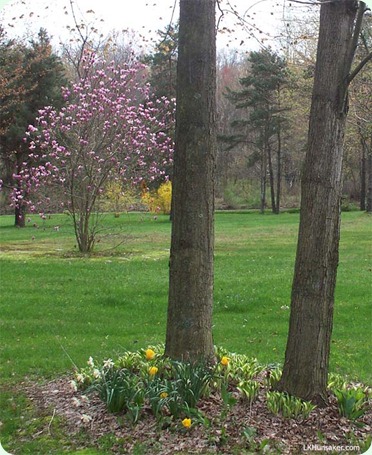
This May Day
I reclaim my spirit
with music
(David Garrett’s gorgeous violin)
with birds singing outside my open window
with a day of rest
after physically tiring, mentally healing
days of working in the gardens
with writing
having recaptured
the spirit
of the writing
itself
May I hold it,
cherish it,
remember
why.
And May you.
”There are two things to aim at in life;
first to get what you want,
and after that to enjoy it.
Only the wisest of mankind
has achieved the second.”
Logan Pearsall Smith
(from my calendar for May)
~
Monday, April 25, 2011
Artificial Barriers

Ronald Reagan
Pessimists blame themselves for what goes wrong and credit external forces for things that go right.
Both are necessary to an extent. Sometimes things happen just because they do. It’s life. Good and bad both happen and whether something is good or bad depends on our personal viewpoint. We can’t control world events.
Or can we?
I’ve been reading Marilynne Robinson’s The Death of Adam. It’s a slow read, and I had to pull my dictionary to my side (now, I have a good vocabulary but hers is apparently better) and jot notes while I read. It’s a book of essays on modern thought. Very intriguing for those who wonder why we are where we are these days.
One thing in the first essay, Darwinism, that struck me was the very loud and clear fact of how deeply influential writers can be on their worlds, and not only their small worlds but on the whole larger world. She argues that Nietzsche and Darwin and Freud, in their insistence that man is base and aggressive in nature and that our main object is self-survival (or survival of the fittest) helped lead to Nazism. At that time, she says, Europeans were growing weary of the Christian ethic of having to take care of their poor brethren and so the idea of survival of the fittest, that basically told them the weak shouldn’t survive, grew in leaps and bounds as these three authors spread the thought.
Modern scientific thought spread, since it made the intelligentsia feel absolved of the fact that they owed it to others to help care for them, and started to try to negate the “truth” of religion. They didn’t want the guilt that came from not helping their neighbors and so latched onto this survival of the fittest attitude. University professors were among them, and they took it to their students. It’s much easier to absolve yourself of guilt if you believe it’s nature and therefore the real truth that we’re meant to put ourselves first.
Of course, while trying to disprove religion, which they were unable to do, they also were unable to prove their own theory.
That hardly mattered. Anything that gives people the easier way out will spread easily and heartily.
However, what they didn’t count on was the rigid fight of people who refused to believe they shouldn’t help their neighbors just because it felt like the right thing to do. They stubbornly held onto their “love thy neighbor” Christianity.
I read someone’s question this morning as to what eggs and bunnies have to do with Easter, and for that matter, what Santa has to do with Christmas. Although I knew the basics, I did do some minor research real quick to support my answer. Santa Claus came from Saint Nicholas. American colonists grasped onto the giving and generous Dutch Bishop Nicholas rather than the English Saint George and followed his example by giving gifts to others. American writer Washington Irving picked that up, used some creative imagination, and turned him into “Jolly Saint Nick” in a story to help spread the idea of giving with glee. From there came “The Night Before Christmas” furthering the idea of the “bowl full of jelly” and the red suit to match his red cheeks. And from there, artists picked up the image and ran with it. Santa Clause comes from “Sante Claus” meaning “giver to children.”
So this time, writers were spreading the idea of giving and sharing and joy.
The effect of both sets of writers are still with us. Although people in general may not be aware of the scientists’ actual philosophies and their words that said it’s in humanity’s best interest for the weaker among us to be extinguished, the idea is still in our general worldly psyche. The weaker are still being extinguished. Too many among us still think it’s okay to sit back and let it happen.
There is a point to survival of the fittest to some extent, but how do we define “fit”? By the ability to create weapons and technology? Or by the ability to still love through the hate? Which is the more fit, the stronger?
There is still no proof they were correct in their theory, with too much of it left unexplained. And personally, I’d say there is plenty of proof they were not. If they had been, and if all through the centuries survival of the fittest was actually at work, then wouldn’t we stop making the mistakes of the past, stop fighting over theoretical differences, over religious differences? Wouldn’t we know by now which was the “best” way of building a society and wouldn’t more societies be so much kinder to their populations than they are? If the best, strongest, and brightest of us were the ones surviving, at this point, wouldn’t we be much smarter than we are? I don’t see that we are any smarter or more fit than humans ever were.
I do see that goodness and the innate love for each other has gone a long way in conquering the selfish “rid ourselves of the weak” attitude. I’d say it proves the “take care of yourself first” theory of man incorrect since we have whole nations of people fighting for the rights and safety of strangers and supporting that for no other reason except we are supposed to love our brothers, know them or not. And innately, we do. How else do you explain someone stopping to help a stranger on the sidewalk if he has a heart attack? Most of us would do what we could. Why? Survival of the fittest would tell us to leave him be, that he’s weak and deserves to die and there will be more resources for the rest of us. We don’t, though. We help. Whatever our religion, and even if we have no acknowledged religion, we would try to help.
The barriers to furthering the growth of love and kindness have been artificially made, in part by those spreading the defeatist attitude purposely. Their effect can be defeated. But to do so, we have to start by understanding the roots. We have to tear down the boundaries that we’ve created within ourselves and listen, pay attention, grow … instead of blocking out what we do not wish to hear and making things “easier” for ourselves which in turn makes things much harder for everyone.
Words do matter. What you spread matters. And it ripples. Using the excuse of “human nature” is a cop out. Identify the constraints within yourself, grab hold of them, and tear them down.
The simple fact that many of us have been able to break through boundaries and achieve is proof that all of us can. If we will. (paraphrased from Reagan)
---
Friday, April 08, 2011
Independence: Have we forgotten the meaning?

I was introduced to someone writing his first novel the other day as an author. He asked if I had books out. I answered that I have 5 novels and a children’s book available. He appeared duly impressed until he asked how I got into the industry, since what he found looks daunting. I told him I publish myself.
At that, he gives me that “Oh. Never mind, then.” look and changes the subject. I could have told him he was shooting himself in the foot for brushing me off as though I could no longer be helpful to him. I could have told him he should try to READ my work before dismissing me so easily. I didn’t bother. I have plenty to do. I get plenty of calls for advice or assistance. I’m not looking to handhold someone who brushes me off so easily. It is actually his loss, as I have been studying publishing issues since around 1999, while in process of my own first novels. I pay attention. Just because I don’t use a publisher, that doesn’t mean I don’t have valuable information.
More importantly, just because I publish myself, it doesn’t mean my books don’t stand up with traditionally published books.
In fact, I just picked up a clearance Danielle Steele a couple of days ago. I’ve never read her. I kept thinking I should since I’m so often asked if my books are like hers. Since I’ve heard she’s steamy, I’ve said I don’t think they are, but I like to be better informed than that. So, I’m 1/3 way through Jewels and … I’m skimming. I keep thinking: “This is the ‘great’ Danielle Steele?” Has anyone read several of her books? Is Jewels typical of her writing? To be honest, I find it rather sophomoric and horribly repetitive and much more telling than showing, not to mention she jumps POV right and left and up and down. Ugh! Now I understand why so many romance readers start thinking, “Hey I can do this.”
Yes, generally that’s a fair assumption if she’s the standard and since editors will help to tighten your work before they publish it. To be fair, I am still reading. I do like the hero and heroine well enough to keep following their story. And it won’t take long, since I’m skimming over the repetitious prattle-filler.
I once had a fellow author say she usually skims books and skips part of the narrative, but with mine, she has to read every word for fear she’ll miss something. A huge compliment and one I won’t forget. Why waste time writing scenes readers will skip over?
Anyway, I’m getting off track. The point was that I don’t understand the turn-off of independence these days.
The other day I read Nathan Bransford’s blog where he questioned who had the right to use the term “indie”: authors or small publishers. It seems no one understands what Indie means. Hm. It’s short for Independent and it is that simple.
Contracted authors have … well, contracts. They submit their work for possible publication and if accepted, that company formats, publishes, distributes (aka PAYS for) the book. In return, the author gets a set amount of royalties and gives up her rights to that book for some specified amount of time. Note that if a publisher buys the rights to your book and doesn’t bother to put it out, there’s not much you can do about it since you signed the contract. I had an author tell me it happened to her, years before, and she was still fighting to get her rights back. Ouch.
Independent authors don’t have contracts that give any rights away to their work. They do sign printing and distribution agreements, but if they’re smart enough to do that with the right company, they can revoke that right at ANY point just because. In short, they pay their own way for their book to be on the market. They don’t ask permission to be published. They can give the printing/distribution rights to twenty different sites/companies if they wish and pull them at any time. (Be aware that with ebooks, any copies sold cannot be retracted if you pull your book from the site! Readers have rights, too.) Independent. Paying their own way. Indie.
So, authors paying their own way are Indie Authors, regardless of who they pay to help them format and cover design and edit and distribute. It’s their money. It’s their own name (or their own company name), for better or worse. They aren’t relying on a publisher name to help them sell. They rely on the quality of their work and their ability to market themselves.
In the same vein, small publishers not affiliated with the big guys, who use their own funds to publish authors, are Indie Publishers. This is the same as independent bookstores owned by those who pay their own bills and run the store under their own name.
If you pay your own way and use your own name, you are indie. It is that simple. (Being published by an indie publisher does NOT make you an indie author. They are paying; you aren’t. You are contracted to them.)
Why do we have such a grudge against independent-minded entrepreneurs? Because some big company started the idea that you must go through them to establish quality? Please. We all know that all big companies put out very “non quality” products often. Look at all of the recalls. Look at some of the books coming out by the “quality” big houses. Reality stars? Is that quality literature? No. But it is big money. That’s what they’re about. Don’t confuse the two.
Bigger doesn’t imply better. Or it shouldn’t.
I’m an Indie Author (which I’ve been saying since 2005, before I heard anyone else use the term) for the same reason my ancestors helped to fight for America’s independence. We are do-it-yourselfers not afraid to go it on our own and pay our own way and earn the right to keep the profit of our labor. I’m not asking anyone else to risk their funds on the hopes of making money from their risk. I’m not giving away my rights to my own work. I’m also not taking the easy way out. Trust me: being indie is the hard path, particularly when you’re trying to do it as well as you can and make a quality name for yourself.
I’m not afraid of hard work. I’m not asking for help or handouts. I’m a qualified DAR who still believes in the independent spirit of standing on your own two feet and working for what you want instead of asking for it.
I see nothing wrong with that. Give me liberty..
and don’t stand in my way.
~~
Wednesday, March 30, 2011
Spring Decluttering
 Vincent Van Gogh sold only one painting during his lifetime. (not this one – but it’s one of my favorites) Think about that one a moment. His paintings now go for millions of dollars each and yet, he got nothing for them, other than the love of the art. Does that make him crazy?
 Well, he was indeed mentally ill. Just which affliction he had has been debated and cannot be proved. Still, along with some of the most beautiful, stirring artwork ever produced, he also left behind a huge series of letters to his beloved brother Theo. I’m reading Irving Stone’s edited version of the most important of those letters. He could have been a writer. His words are beautiful, as well.
”If one really loves nature, one can find beauty everywhere.”
It has me wishing he’d set the studies aside earlier and began focus on his true love earlier.
Of course, I often wish I’d done the same. I spent too many years not writing when I could have. Now, I’m finding myself pulled in many directions that yank away writing time.
I need more time and more focus for my art. Even if I don’t get more out of it than Van Gogh did during my lifetime, at least it’ll be out there. Maybe some day someone will wish I’d started earlier. Since I can’t do that, I can at least make better use of the time to come, whatever that may be.
I’m also quite grateful to live in a time where people can get mental help if they need it – just in case, you know – and wish they could have helped him at the time.
It’s also comforting to know he had constant doubts about his art. Most artists do, whether or not they are selling. It’s part of an artist’s curse: subjectiveness. There is no way to determine actual quality of art. Some people will detest the same piece others love. I suppose as long as some love it and enjoy it, that needs to be good enough. But a real artist will never accept that. What can you do?
”It is certainly true that it is better to be high-spirited, even though one makes more mistakes, than to be narrow-minded and all too prudent. It is good to love many things, for therein lies the true strength, and whosoever loves much performs much, and can accomplish much, and what is done in love is well done!”
~~
All quotes taken from Dear Theo: The Autobiography of Vincent van Gogh, Edited by Irving Stone, Plume, 1995.
~~

Thursday, March 17, 2011
Book Review: The Princes of Ireland

I’ve yet to read Michener (*blush*) but if he fills his books with as much history as Rutherfurd, I look forward to doing so.
I’m enamored of Ireland. Maybe it’s my more-than-a-quarter Irish blood. But I like to think it’s because of the spirit of the Irish: hardy, humorous, independent-minded, rebellious. Of course, as becomes apparent in The Princes of Ireland, that applies more to western and southern Ireland than to eastern Ireland (Dublin and thereabout). We were there in 2008, in both Dublin and out along the west coast (Galway, the Burren, Cliffs of Moher, Kilfenara), and although I enjoyed 
When the novel began, I felt a true excitement of being “there” at the Pagan beginnings of the “western 
As it went along, I began to have the feeling that it was more non-fiction than fiction, with hints of Story tying the events together and connecting them through the centuries. It does read largely as non-fiction. There are a plethora of details, names, ruling families that can be hard to keep all together from beginning to end. In fact, this one would be a good candidate for multiple reads (although I’ve yet to do that, either). It’s a very long novel. Expect to spend plenty of time with it.
Also expect to come away with a new understanding of Ireland and its mix of people and cultures, from Druids to Vikings to Scottish warriors to St. Patrick’s Christians to English slaves, and later to English Catholic colonizers. And expect to
The Princes of Ireland is very highly recommended for Ireland enthusiasts, religion enthusiasts, as well as history enthusiasts in general.
Happy St. Patrick’s Day!
By the way, St. Patrick’s Cathedral (shown above) is a protestant church and corned beef and cabbage is not a traditional Irish food. It’s Americanized Irish created by Irish immigrants who had to cure their meat well enough to transport it. In my view, that makes it the perfect American Irish way to celebrate the day!
~~~